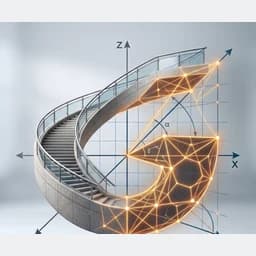
Suspension bridge cable
The Parabola
Nobody bent that cable to match an equation. The cable found its own shape. So why this shape?
Three ways to see it
A cable hanging between two towers. It dips in the middle, rises at both ends. Hundreds of vertical wires drop from it to the road below, spreading the weight of the road evenly along its length.
Switch layers — the scene stays put
What's really going on
Here's the real surprise: a freely hanging chain does NOT trace a parabola. A chain carrying nothing but its own weight settles into a different curve, and that curve has a name of its own: the chain curve, or catenary. What turns this cable into a parabola is the road hanging beneath it — the moment weight spreads evenly along the road instead of along the cable, the curve becomes parabolic. So the shape isn't caused by the cable; it's caused by the load. Looking at a curve and calling it a parabola is really reading how weight is distributed.
The equation
y = a·x²
As you move away from the lowest point, height grows with the square of the distance. The number 'a' says how tightly or widely the curve opens.
Same concept, elsewhere
Memorising one example gets you nowhere. You need to spot the concept wherever it turns up.
The curve you trace through the air diving into a pool — anything thrown under gravity follows a parabola
A satellite dish: its parabola-shaped surface gathers every incoming signal onto one point
A car headlight: put the bulb at the parabola's focus — the one point where the curve gathers everything — and the light leaves in a straight, parallel beam
The curve the water traces in the air as it leaves a fountain
Founding pack
15 days of full access
Have your own photos read, open every member-only concept, keep your progress. Not a subscription — it doesn't renew itself, and when it ends you decide whether to carry on.
One-time payment. Walk away whenever you like.